Most zines are sized by folding standard paper. From a US Letter sheet (8.5 × 11 in) you get a half-letter zine (5.5 × 8.5 in), a quarter-letter zine (4.25 × 5.5 in) or a one-sheet mini zine (2.75 × 4.25 in). From A4 you get A5, A6 and A7. For inside pages, use 20–24 lb bond (75–90 gsm) copy paper; for covers, 65–80 lb cover stock (about 176–216 gsm).
In this guide
You do not choose a zine size from a list of thousands. You choose a sheet of paper and decide how many times to fold it. That is why zine sizes are so consistent, and why understanding paper (its size, weight and grain) solves half the problems beginners blame on their folding.
Zine sizes from one sheet
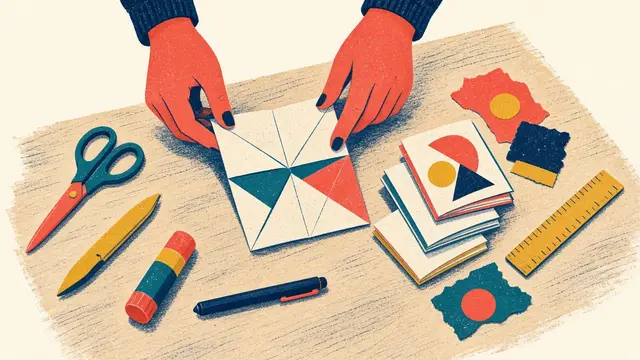
Every fold halves the sheet. Fold US Letter once and you get half-letter; cut that in half and fold again and you get quarter-letter. A-series sheets work the same way, which is their whole design: A4 halved is A5, A5 halved is A6.
Sizes from US paper
| Zine size | Finished page | Made from | Pages per sheet (both sides) |
|---|---|---|---|
| Half-letter (digest) | 5.5 × 8.5 in | Letter folded in half | 4 |
| Quarter-letter | 4.25 × 5.5 in | Letter cut in half, each half folded | 4 per half-sheet |
| One-sheet mini zine | 2.75 × 4.25 in | One Letter sheet, folded and cut once | 8 (one side printed) |
| Letter booklet | 8.5 × 11 in | Tabloid folded in half | 4 |
| Legal mini zine | 3.5 × 4.25 in | One Legal sheet (8.5 × 14 in) | 8 |
| Tabloid mini zine | 4.25 × 5.5 in | One Tabloid sheet (11 × 17 in) | 8 |
Sizes from A-series paper
| Zine size | Finished page | Made from | Pages per sheet (both sides) |
|---|---|---|---|
| A5 | 148 × 210 mm | A4 folded in half | 4 |
| A6 | 105 × 148 mm | A4 cut in half, each half folded | 4 per half-sheet |
| A7 mini zine | 74 × 105 mm | One A4 sheet, folded and cut once | 8 (one side printed) |
| A4 booklet | 210 × 297 mm | A3 folded in half | 4 |
| A6 mini zine | 105 × 148 mm | One A3 sheet | 8 |
A-series sheets keep the same proportions every time you halve them (the ratio is 1 : √2), so an A5 page looks like a small A4. US Letter does not: half-letter is a little taller and narrower in proportion than Letter. That matters only if you scale a design between the two.
Which size should you choose?
- One-sheet mini zine for your first zine, for comics, for workshops and for anything you want to hand out free. It needs no binding.
- Quarter-letter or A6 for pocket zines, poetry and small art zines. Cheap to mail as a standard letter in the US.
- Half-letter or A5 for most writing-led zines, interviews and how-to guides. The most common “real zine” size.
- Letter or A4 booklets for art, photography and comics that need room. They need Tabloid or A3 sheets and more expensive printing.
Paper weight in lb and gsm
Paper weight is confusing because North America uses several pound systems while most of the world uses gsm (grams per square metre). A higher number means heavier, thicker paper. The two systems that matter for zines are bond (copy paper) and cover (card).
| Paper | US weight | Metric | Use in zines |
|---|---|---|---|
| Everyday copy paper | 20 lb bond | 75 gsm | Inside pages; dark art may show through |
| Premium copy paper | 24 lb bond | 90 gsm | Best all-rounder; crisp and opaque |
| Heavy copy paper | 28–32 lb bond | 105–120 gsm | Premium inside pages; bulky at the spine |
| Light card | 65 lb cover | 176 gsm | Covers; score before folding |
| Medium card | 80 lb cover | 216 gsm | Sturdy covers; check printer limits |
Two practical notes. First, a one-sheet mini zine folds best on 20–24 lb (75–90 gsm); card is too stiff and cracks at the folds. Second, check your printer’s maximum paper weight before buying card. Some home printers take heavier card through a rear or manual feed; others top out well below cover weights, so check the manual.
Paper grain: the hidden reason folds crack
Paper is made of fibres, and in machine-made paper most of them line up in one direction: the grain. Paper folds smoothly along the grain and resists, ripples or cracks across it. On copy paper the difference is small. On card, it is the difference between a crisp cover and a split one.
Finding the grain
- The bend test. Gently bend the sheet without creasing, then turn it 90° and bend again. It bends more easily when the fold line is parallel to the grain.
- The tear test. Tear a scrap each way. It tears straighter along the grain.
- The label. Packs often say “grain long” (grain parallel to the long side) or “grain short”.
For booklets, the rule is simple: keep the grain parallel to the spine. For a half-letter booklet folded from Letter, that means grain short paper, because the fold runs across the short side. For copy paper you can usually ignore it. For covers, check.
Scoring heavy paper
Scoring presses a groove where the fold will go, giving the fibres somewhere to bend instead of crack. Lay a metal ruler along the fold line and run a bone folder, an empty ballpoint pen or the back of a butter knife along it with firm pressure, then fold along the groove.
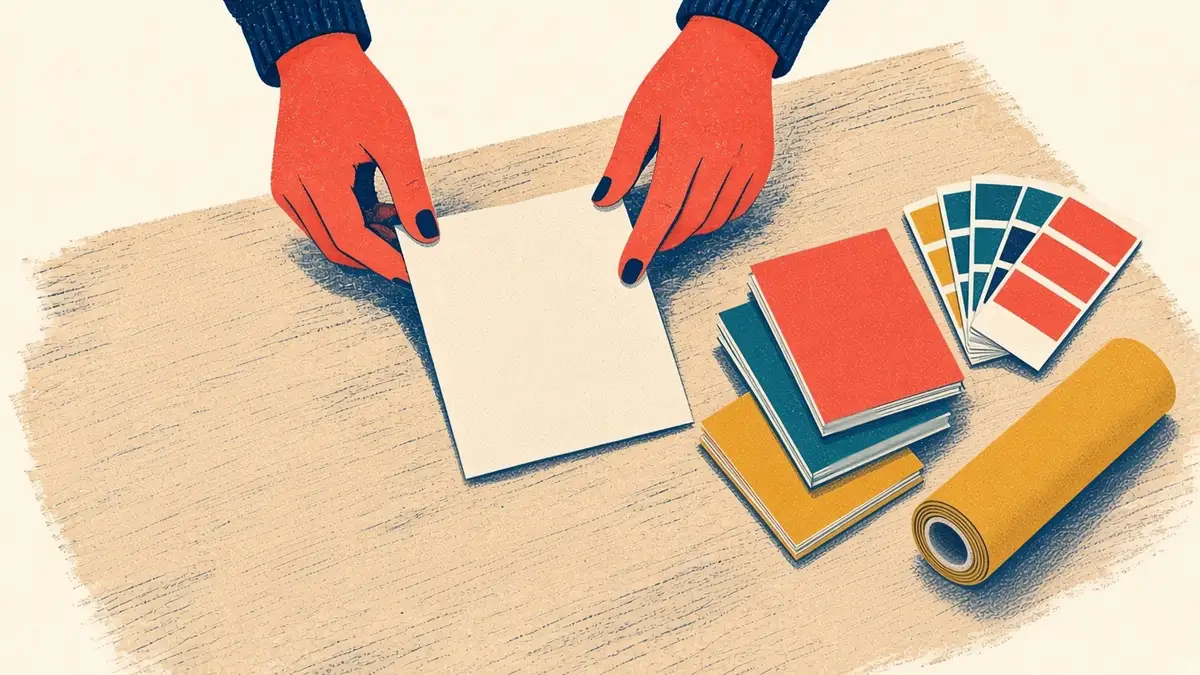
Coloured, kraft and found paper
Coloured copy paper costs barely more than white and changes the whole mood of a zine. Kraft paper makes a warm, rough cover. Found papers such as maps, wrapping paper and old book pages make striking covers, but check they will run through your printer before you commit an edition to them. Dark papers make black ink hard to read: test one copy first.
Get the templates in your size
The free template pack comes in both US Letter and A4 editions, so every template prints at 100% on the paper you actually have, with a scale bar to check. For folding, binding and printing in every one of these sizes, including the 16-page zine from a single Tabloid or A3 sheet, see The Complete Zine Making Handbook.
Frequently asked questions
What is the standard zine size?
There is no single standard, but the most common size in North America is half-letter, 5.5 × 8.5 in, made by folding US Letter sheets in half. In countries that use A-series paper, the equivalent is A5 (148 × 210 mm), made by folding A4.
What size is a mini zine?
A one-sheet mini zine folded from US Letter has pages of 2.75 × 4.25 in. From A4 the pages are 74 × 105 mm, which is A7.
What paper weight is best for zines?
For inside pages, 20–24 lb bond (75–90 gsm) copy paper is the best all-rounder: cheap, opaque enough, and easy to fold. 24 lb / 90 gsm is noticeably crisper. For covers, 65–80 lb cover stock gives a finished feel; score it before folding.
Is A5 the same as half-letter?
No, but they are close. Half-letter is 5.5 × 8.5 in (140 × 216 mm); A5 is 148 × 210 mm (about 5.8 × 8.3 in). A5 is slightly wider and slightly shorter, so templates for one do not fit the other exactly.
What is paper grain and why does it matter for zines?
Grain is the direction most fibres lie in a sheet. Paper folds cleanly along the grain and tends to crack or ripple across it, especially heavier card. For booklets and covers, keep the grain parallel to the spine.