A zine (pronounced “zeen”, short for fanzine or magazine) is a small, self-published booklet made by one person or a small group, usually photocopied in a short run and shared, swapped or sold for a few dollars. Zines can be about anything: a hobby, a city, a comic, a cause or a single ordinary day. The maker controls every page, with no editor or publisher in between.
In this guide
A zine is the most direct form of publishing there is. You decide what goes on the page, you make it with whatever you have, and you hand a copy to someone. No submissions, no gatekeepers, no minimum print run. That freedom is why zines have outlived every prediction of their death, from the arrival of the web to the rise of social media.
This guide explains what a zine is, how zines differ from magazines and books, where they came from, the main kinds people make today, and what you actually need to make one this afternoon.
What makes something a zine
There is no official definition, and zine makers tend to resist one. But most zines share five traits:
- Self-published. The maker writes, draws, lays out and produces it, alone or with a few friends.
- Small run. Ten copies, fifty, a few hundred. Rarely thousands.
- Cheap to make. Photocopiers, home printers and risograph machines are the usual presses. Paper, a stapler and scissors are the usual bindery.
- Made for love, not profit. Prices cover costs, if there is a price at all. Trading one zine for another is a long tradition.
- Personal control. There is no editor softening the voice or advertiser shaping the content. That is the point.
If something you made meets most of those, you can call it a zine. Many makers would add a sixth: a zine is physical. Digital zines exist, but the folded, stapled object is still the heart of the form.
Zine vs magazine vs book
The easiest way to understand a zine is to compare it with the things it is not.
| Zine | Magazine | Book | |
|---|---|---|---|
| Made by | One person or a small group | A paid staff | An author with a publisher, or self-published |
| Funded by | The maker, covered by small sales or trades | Advertising and subscriptions | Book sales |
| Typical run | 10 to a few hundred copies | Thousands or more | Hundreds to millions |
| Production | Photocopier, home printer, risograph; folded and stapled or sewn | Commercial offset printing | Commercial printing and binding |
| Price | Free to a few dollars, or a trade | Retail cover price | Retail price |
| Voice | Entirely the maker’s | Edited to a house style | Edited |
A zine can look rough or immaculate. What matters is who controls it.
A short history of zines
The word comes from fanzine, a fan magazine. In the 1930s, science-fiction fans in the United States began mimeographing their own amateur magazines of stories, letters and reviews and mailing them to each other. The Comet, produced in 1930 by the Science Correspondence Club in Chicago, is often cited as the first. The word fanzine itself appeared around 1940.
From there the form spread to every subculture that felt ignored by mainstream media:
- Punk zines (1970s). Cheap photocopying made it possible for anyone to print a music zine. London’s Sniffin’ Glue (1976) became the famous example of the cut-and-paste, photocopied look many people still picture when they hear the word.
- The network era (1980s). Factsheet Five, started by Mike Gunderloy in 1982, reviewed thousands of zines and connected makers by mail across North America.
- Riot grrrl (1990s). Feminist punk zines such as Bikini Kill and Jigsaw turned the perzine, the personal zine, into a tool for politics and community.
- Libraries and fairs (2000s onward). Libraries such as the Barnard Zine Library in New York began collecting zines as historical documents, and zine fests grew in cities around the world.
Today, zines sit comfortably alongside the internet rather than being replaced by it. Many makers sell printed copies at fairs and post a PDF online. Teachers use zines to teach writing and design. Community print studios run risograph workshops. The form keeps returning because a small, finished object you can hold does something a feed cannot.
The main kinds of zine
Most zines are a blend, but these labels are useful when you are looking for ideas or describing your work to a shop.
- Perzine (personal zine). Diary entries, memories, lists, a single day. The most common first zine.
- Fanzine. Devoted to a band, game, film, book, team or fandom.
- Comic or minicomic. Sequential art, often on the eight-page one-sheet format, which happens to give exactly one panel per page.
- How-to zine. Recipes, repairs, plant care, bike maintenance, a craft technique.
- Local or city zine. A guide to one street, the best benches in town, a neighbourhood’s history.
- Political or issue zine. Explainers, know-your-rights guides, community organising.
- Art zine. Collage, drawings, photography, pattern, colour studies. Often wordless.
- Poetry or literary zine. Short fiction, poems, essays.
- Compilation or group zine. One page per contributor, assembled by an editor; common in classes and clubs.
If you are stuck for a subject, our zine ideas guide breaks fifty prompts down into eight-page plans.
What a zine looks like physically
Most zines are made by folding sheets of standard paper, which means their sizes follow the paper.
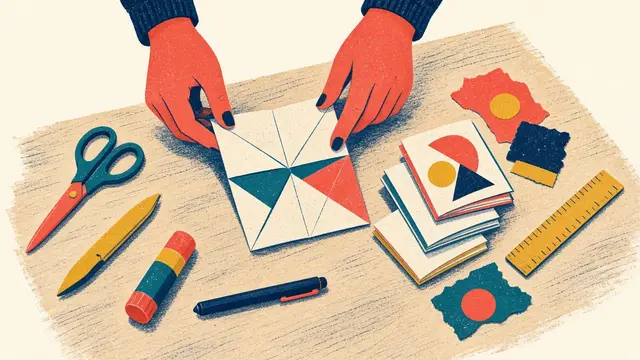
- The one-sheet mini zine. One sheet of US Letter or A4, folded and cut once, gives eight small pages (2.75 × 4.25 in from Letter; A7, 74 × 105 mm, from A4). No staples needed. Here is exactly how to fold one.
- The half-letter or A5 booklet. Sheets folded in half and stapled through the fold, giving 5.5 × 8.5 in or A5 pages. The classic “digest” zine.
- The quarter-letter or A6 booklet. Pocket-sized, made by cutting sheets in half before folding.
- Folded formats. Accordions, map folds and posters that open out.
Because every folded sheet makes four pages, folded zines always have a page count that is a multiple of four. The page order on the sheet is not the reading order, which is why page maps matter. Our guide to zine layout and imposition explains it simply.
What you need to make a zine
Less than you think. For a first zine:
- One sheet of copy paper
- Scissors
- A black pen (fineliners photocopy best)
- Optional: a glue stick and old magazines for collage
That is enough for a complete eight-page mini zine in under an hour, including the folding. When you want more copies, a home printer or photocopier turns your original (the master) into an edition. When you want something more substantial, a long-reach stapler or a needle and thread turns folded sheets into a booklet. The guides to binding and printing cover both.
Why people make zines
Ask ten makers and you will get ten answers, but a few come up again and again:
- To finish something. A zine is small enough to complete in a day, and finished work is motivating.
- To be heard without permission. No algorithm decides who sees your zine. You decide who gets a copy.
- To make friends. Trading zines at fairs and by post is one of the oldest social networks there is.
- To teach and learn. Writing to fit eight small pages is a brilliant discipline for clarity. Teachers know this, which is why zines turn up in classrooms and libraries. If you teach, see our zine workshop lesson plan.
- To document. Zines record local scenes, personal histories and moments that larger media never cover. Libraries collect them for exactly that reason.
Your next step
The fastest way to understand zines is to make one. Take a sheet of paper and follow the one-sheet mini zine tutorial, or print a ready-made, actual-size template from the free reader bonuses. For the whole journey, from that first fold to a stapled edition on a fair table, the full method is in The Complete Zine Making Handbook.
Frequently asked questions
How do you pronounce zine?
Zine is pronounced “zeen”, like the end of magazine. It comes from fanzine, the name science-fiction fans gave their amateur magazines in the 1930s and 1940s.
What is the difference between a zine and a magazine?
A magazine is a commercial product made by a staff, funded by advertising and subscriptions, and printed in large runs. A zine is made by one person or a small group, usually without ads, printed in short runs on a copier or home printer, and shared for little or no money. The maker controls every page.
Are zines still a thing?
Yes. Zine fairs run in many cities, public and university libraries collect zines, community print studios offer risograph and copier access, and teachers use zines in classrooms. Many makers now share a free PDF alongside the printed copies.
How many pages does a zine have?
There is no fixed number, but folded zines grow in multiples of four because every folded sheet makes four pages. The classic one-sheet mini zine has eight pages including the covers; booklets of 12, 16, 20 or 24 pages are common.
Do you need permission to make a zine?
No. Anyone can make and share a zine. You do need to respect copyright when you use other people’s images or text, and get consent before writing about real people in a way that identifies them.